
Substack + Telegram: How to Run a Private Paid Community Without Creating an Ops Mess
Substack can handle paid subscriptions with Stripe. Telegram can handle the real-time community layer. Here's the clean setup for private paid groups, onboarding, moderation, and access automation.
Live directory
Browse Metricgram's curated Telegram directory to find active communities by category and language, and see how leading groups position their listings.
Open directoryThe Stack Makes Sense. The Manual Work Does Not.
If you run a paid Substack, you already have the hard part in motion: people trust you enough to pay for your writing.
The next logical step is usually community. Not a comment section. Not a loose social feed. A place where paying readers can ask questions, react in real time, share wins, and feel closer to the work.
For many creators, that place ends up being Telegram.
Why? Because Telegram is fast, mobile-native, easy to join, and built for active conversation. Groups can scale far beyond a tiny mastermind chat, and Telegram gives admins granular privileges, bots, pinned messages, invite links, and other operational tools that serious communities need. According to Telegram's official FAQ, groups can support communities of up to 200,000 members and admins can be assigned granular privileges.
The problem is not choosing Substack plus Telegram.
The problem is what happens after that choice:
- manually sending invite links to every new paid reader;
- manually removing access when someone cancels;
- manually answering the same onboarding questions every week;
- manually checking who still belongs in the group and who should already be out.
That is where a good community idea turns into admin debt.
What Substack Already Does Well
Substack already covers a big part of the paid-creator stack.
Per Substack's Help Center, you can turn on paid subscriptions by going to your publication settings, opening Payments, and clicking Connect with Stripe. Once connected, you can offer monthly, yearly, and founding member plans.
Substack also has its own community surface:
- Chat can be enabled from publication settings.
- Chat can be paywalled for paid subscribers or founding members.
- You can control who can start threads.
- You can moderate reader participation inside Substack itself.
That means Substack Chat is a valid default if your goal is:
- lightweight discussion around posts;
- a subscriber-only conversation space inside the Substack product;
- a simpler setup with fewer moving parts.
That is important to say clearly, because it makes this article more useful: not everyone needs Telegram.
Ready to improve your Telegram group? Start your 14-day Metricgram trial.
Start free trialWhen Telegram Becomes The Better Community Layer
Telegram becomes the stronger choice when your paid community needs more of the following:
- fast conversational cadence instead of slow thread-based discussion;
- stronger moderation workflows;
- multiple admins or moderators with different roles;
- automation through bots;
- operational separation between free and paid spaces;
- a community that feels like a room rather than an extension of the publication UI;
- premium groups that support coaching, alerts, office hours, launches, or live interaction.
In other words:
- Substack is excellent for subscription and publishing.
- Telegram is excellent for live community operations.
Used together, they can be a very strong creator stack.
The Clean Architecture
The cleanest setup looks like this:
- Substack handles publication, email distribution, and paid subscription plans.
- Stripe remains the payment source of truth for the subscription.
- Telegram hosts the private community.
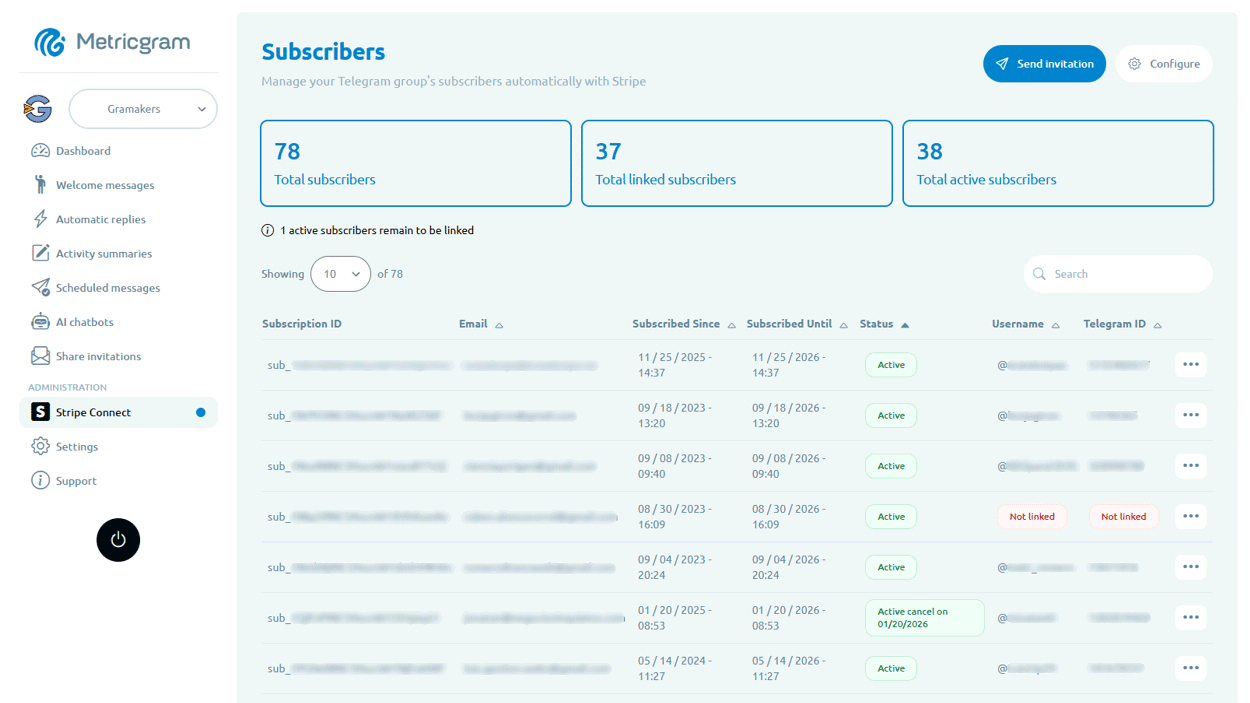
- Metricgram automates access, removals, welcome flows, and admin operations around the Telegram group.
That last part matters more than it sounds.
Without an automation layer, the workflow usually looks like this:
- Reader upgrades on Substack.
- You notice the payment.
- You send a link manually.
- You hope they join with the right Telegram account.
- They cancel later.
- You forget to remove them.
That process is manageable at 10 members. Annoying at 30. Error-prone at 100. Completely unreliable once the community becomes a meaningful revenue stream.
A Practical Setup, Step by Step
1. Set Up Paid Subscriptions In Substack
Start with the publication economics.
Substack's official setup flow is straightforward:
- connect your publication to Stripe;
- define your monthly price;
- define your yearly price;
- optionally add a founding member tier;
- enable payments when you are ready to go live.
That gives you a proper paid layer with recurring billing and a familiar checkout experience for readers.
Substack also documents that readers can choose among the plans you offer, and that creators on paid subscriptions are charged a revenue share by Substack. So before you add a Telegram community, make sure your pricing already accounts for:
- Substack fees;
- payment processing costs;
- the extra operational work that community introduces.
If your publication is priced so tightly that you cannot support the community well, the group will quickly become a burden instead of an asset.
2. Decide Whether The Paid Group Is The Core Product Or A Bonus
This decision affects everything.
There are two common models:
Model A: The Newsletter Is The Product, Telegram Is A Bonus
This is common for writers and analysts.
People primarily pay for:
- essays;
- research;
- market commentary;
- exclusive posts;
- archives.
Telegram adds:
- Q&A;
- faster reactions;
- closer access;
- reader networking.
Model B: The Community Is The Product, Substack Is The Funnel
This is more common for:
- coaches;
- educators;
- niche operators;
- premium communities with accountability or live support.
People may discover you through the newsletter, but what they are really paying for is:
- access;
- discussion;
- direct answers;
- events;
- tighter feedback loops.
Both models work. But if you do not know which one you are running, your onboarding and pricing will feel messy.
3. Create The Telegram Group Like An Operator, Not Like A Hobbyist
Do not create the group and improvise later.
Make these decisions before inviting anyone:
- Is the group private?
- Who are the admins and what rights do they need?
- What are the rules?
- What is the expected posting behavior?
- What should new members read first?
- What happens when a subscription expires?
Telegram gives you the right primitives here. The official FAQ confirms that you can appoint administrators with granular privileges, pin important messages, and control access history for new members.
That means your group should launch with:
- a pinned welcome post;
- a short rules post;
- at least one admin other than you if the group matters commercially;
- a naming convention that clearly signals this is the paid community, not a public chat.
If you want the group to feel premium, the first five minutes of the member experience matter a lot.
4. Keep Stripe As The Access Trigger
This is the most important operational principle in the whole setup:
payment status should drive access status.
If someone is active in Stripe, they can be in the paid group.
If they are canceled, unpaid, or expired, access should be reviewed or revoked based on your rules.
This is where Metricgram fits naturally into the stack.
Instead of treating Telegram access as a manual favor, you treat it as an automated consequence of subscription status.
That changes the workflow completely:
- new subscriber joins faster;
- churn cleanup happens consistently;
- failed payments stop creating grey areas;
- you stop needing spreadsheets to manage a supposedly premium product.
If your Substack payments are flowing through the Stripe account you connect to Metricgram, Stripe can act as the clean operational bridge between the publication and the Telegram group.
5. Build A Better Paid Onboarding Flow
Paid communities fail less from lack of value than from weak onboarding.
A new paid member should not have to guess:
- where the group link is;
- which Telegram account to use;
- what to read first;
- what kind of questions are welcome;
- how to contact support if access fails.
Your onboarding should include:
Clear Access Instructions
Tell members:
- where to find the invite;
- whether they need to join with the same email identity or simply the right Telegram account;
- what to do if the invite expires.
A "Start Here" Message
Every new member should immediately see:
- what the community is for;
- what is off-topic;
- how often you show up;
- what kind of value they should expect.
First-Week Engagement Prompts
Do not rely on passive joining.
Prompt actions such as:
- introduce yourself;
- share what brought you here;
- tell us your current challenge;
- vote on what you want next.
If you skip this, many paid members will lurk, feel disconnected, and later cancel because "they didn't use it enough."
6. Be Honest About Substack Chat Vs Telegram
Creators lose time when they refuse to make a real choice.
If Substack Chat is sufficient for your use case, use it.
If Telegram is better for the kind of community you want, commit to it.
What does not work well is running:
- Substack comments;
- Substack Chat;
- a free Telegram group;
- a paid Telegram group;
- and maybe Discord too
all at once without a clear reason.
That usually fragments attention and weakens every space.
A simpler rule:
- Use Substack for publishing and subscription.
- Use one main live community layer.
- Use Telegram only if you truly need Telegram's speed, bot ecosystem, moderation patterns, and premium-group feel.
7. The Real Risk Is Not Tech. It Is Operational Leakage.
Most creators think the hard part is connecting tools.
It is not.
The hard part is operational leakage:
- someone pays and never gets in;
- someone cancels and stays inside for months;
- admins do not know who should still have access;
- support requests pile up because access is ambiguous;
- the group becomes noisy because no one owns onboarding and moderation.
That is why tools like Metricgram matter in this stack.
The product is not abstract "Telegram analytics" or "automation." In this context, it is the operational layer that keeps a paid Telegram community from turning into manual chaos.
When Metricgram Starts Paying For Itself
For a tiny paid group, you can do some things by hand.
But once you have:
- multiple plans;
- recurring churn;
- more than one admin;
- periodic failed payments;
- readers joining from different campaigns;
- a need for welcome messages, rules, analytics, or moderation
the manual version becomes more expensive than it looks.
The cost shows up in:
- missed removals;
- weaker retention;
- messy onboarding;
- support overhead;
- premium members getting a low-premium experience.
That is the point where Metricgram stops being a nice-to-have and becomes part of the business logic of the community.
The Best Way To Think About This Stack
Think of it like this:
- Substack sells and publishes.
- Stripe confirms who is active.
- Telegram hosts the conversation.
- Metricgram keeps the community operationally sane.
That is a much better system than trying to manually glue paid readers to a private group forever.
Final Recommendation
If you are a writer with a light subscriber discussion layer, test Substack Chat first.
If you are building a higher-touch paid community where speed, moderation, automation, and access control matter, Telegram is often the stronger destination.
And if you choose Telegram, do not run the paid access workflow manually any longer than necessary.
That is the mistake that makes good creator businesses feel much harder to operate than they should.
Want to run a private Telegram community around your paid publication without turning it into an admin job? Try Metricgram and use Stripe as the operational bridge between subscription status and group access.
Ready to manage your Telegram group with Metricgram?
Automate tasks, track analytics, and grow your community with a 14-day free trial. No credit card required.
Start free trialGet weekly Telegram community tips
Join community managers who receive our best tips, guides, and product updates.
You may also like
Telegram For Educators: How To Run Cohorts, Student Communities, And Office Hours Without Replacing Your LMS
Telegram is a strong fit for educators when it is used as the live layer around a course or training business. This guide explains how to use it for cohorts, student communities, office hours, and support without turning it into a substitute for your LMS.
Telegram MCP Server: Give AI Agents the Full Telegram Bot API, Safely
What a Telegram MCP server is, why wrapping the Telegram Bot API for AI agents is harder than it looks, and how Metricgram exposes 70+ Bot API methods as secure, group-scoped MCP tools.