
How to Boost Engagement in Your Telegram Group
Your Telegram group is going quiet? Here's a practical playbook to revive engagement using gamification, scheduled content, auto-replies, and community-building strategies.
Live directory
Browse Metricgram's curated Telegram directory to find active communities by category and language, and see how leading groups position their listings.
Open directoryThe Silence Problem
Every group admin knows this feeling. You open your Telegram group and see... nothing. No new messages. No reactions. The last post was yours, three hours ago, and nobody responded.
It's not that your members left. They're still there — the member count proves it. But they've gone silent. They're reading (maybe), but not contributing. Your group has become a one-way broadcast channel, and that's not what communities are for.
The good news: silence is fixable. Here's a battle-tested playbook for turning passive lurkers into active participants.
Why Groups Go Quiet
Before fixing the problem, understand why it happens:
1. No Reason to Post
If your group is purely informational — you share content, members consume it — there's no natural trigger for conversation. Members need a reason to type something.
2. Fear of Being Wrong
In professional or educational groups, members may hesitate to post because they're afraid of looking uninformed. If the same 3-4 experts dominate every conversation, newcomers feel intimidated.
3. No Recognition
Humans crave recognition. If someone posts a thoughtful comment and nobody acknowledges it — no reactions, no replies, no "great point" — they won't post again. Why bother?
4. Inconsistent Activity
When the group goes through cycles of "super active" and "dead silence," members lose the habit of checking in. Consistency matters more than intensity.
5. Wrong Time Zone
Your most engaged members might be sleeping when you post. If nobody responds in the first hour, the message dies.
Ready to improve your Telegram group? Start your 14-day Metricgram trial.
Start free trialThe Engagement Playbook
Strategy 1: Gamification
This is the single most effective tool for reviving a quiet group. Here's why:
Points create accountability. When members earn points for every message they send and every reaction they give, there's a tangible reward for participation. Even a small number, like 1 point per message, changes behavior.
Leaderboards create competition. Seeing your name on a leaderboard — or just barely missing it — motivates action. People want to climb. It's human nature.
Streaks create habits. Award bonus points for consecutive days of activity. Once someone has a 7-day streak, they're much less likely to break it. The streak becomes self-reinforcing.
Rewards create goals. Points without purpose are meaningless. Create rewards that members actually want:
- Recognition (custom roles, mentions)
- Access (exclusive content, channels)
- Physical items (merchandise, books)
- Services (one-on-one calls, reviews)
- Group perks (ability to post links, pin messages)
How to set it up in Metricgram:
- Go to Gamification settings
- Enable points for messages (e.g., 1 point per message)
- Enable points for reactions (e.g., 0.5 points per reaction)
- Set up daily activity bonuses
- Configure streak multipliers
- Add rewards with point requirements
- Enable the leaderboard
Let it run for a week without announcing it. Then, when members have already accumulated points, reveal the system. "Did you know you've already earned 47 points this week? Check the leaderboard!" Instant buy-in.
Strategy 2: Consistent Content Schedule
Dead groups die because nobody expects anything to happen. Break that pattern with a predictable schedule:
Daily elements:
- Morning: Question of the day or discussion prompt
- Afternoon: Tip, insight, or resource share
- Evening: Open thread or casual chat
Weekly elements:
- Monday: Week's agenda or goals
- Wednesday: Mid-week deep dive
- Friday: Wins of the week or weekend challenge
- Sunday: Weekly summary
Monthly elements:
- Community highlight or member spotlight
- Monthly challenge with prizes
- Feedback survey
You don't need to do all of these. Pick 3-4 that fit your community and be consistent about them. Members should know that every Monday, there's a discussion prompt. Every Friday, there's a challenge.
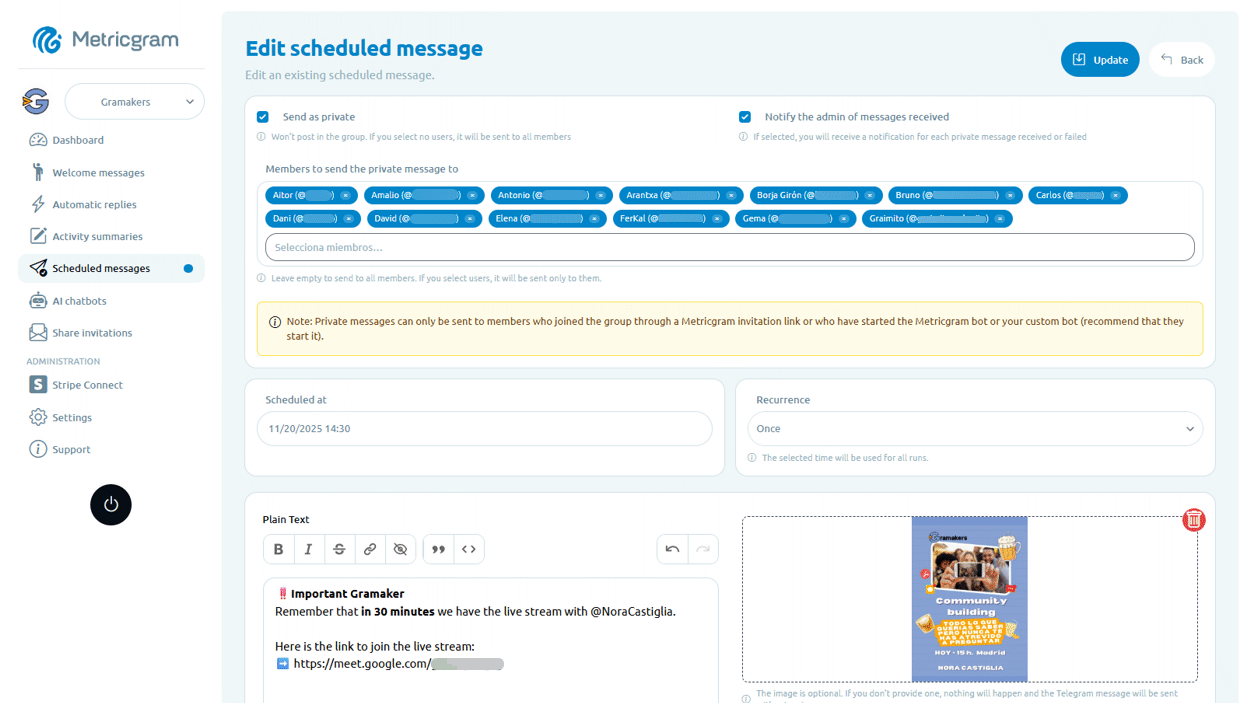
Automate it: Schedule all recurring content in advance using Metricgram's scheduled messages. Write everything for the week in one 30-minute session. The bot handles the rest.
Strategy 3: Ask Questions, Not Make Statements
Compare these two posts:
- "AI chatbots are transforming customer service."
- "Have you tried using an AI chatbot in your community? What was the result?"
The first invites passive consumption. The second invites a response. Every piece of content you share should end with a question or a call to participate.
Good engagement triggers:
- "What do you think about...?"
- "Have you experienced...?"
- "What's your biggest challenge with...?"
- "Drop a 🔥 if you agree"
- "Reply with your [X] for this week"
- Polls and surveys (use Telegram's built-in poll feature)
Strategy 4: Respond to Every Message (At First)
When someone breaks the silence and posts a message, respond immediately. Even a simple "Great question!" or a reaction keeps the conversation going.
This is critical in the early stages of reviving a quiet group. Every unanswered message teaches members that posting here is pointless. Every responded-to message teaches them that this is an active space.
Once engagement picks up naturally, you can step back. But at the start, you need to be the engine.
If you can't always be online: Set up auto-replies for common topics so there's always a response. Enable AI summaries so you can catch up quickly and respond to what matters.
Strategy 5: Create Sub-Groups with Topics
In large groups, the conversation can feel unfocused. Telegram's Topics feature lets you organize discussions:
- General chat
- Questions & help
- Resources & links
- Off-topic / watercooler
- Wins & celebrations
Topics lower the barrier to posting because members can find the right place for their message. Someone who wouldn't post in a general chat might share a win in a dedicated "Wins" thread.
Strategy 6: Spotlight Members
People post more when they feel seen. Create regular opportunities to highlight individual members:
- "Member of the Week" based on activity or contributions
- Feature interesting members with a short interview or spotlight post
- Publicly thank helpful members
- Reference specific member contributions in your content
This works especially well combined with gamification — the top contributor of the week gets featured.
Strategy 7: Create Exclusive Moments
FOMO drives engagement. Create moments that members don't want to miss:
- Live Q&A sessions at announced times
- Limited-time challenges with real prizes
- Guest appearances from experts in your niche
- First-come-first-served offers (e.g., "First 10 people to reply get a free [X]")
- Real-time events tied to external happenings (product launches, market events)
The key is unpredictability. If exciting things happen in the group and you miss them, you start checking in more often.
Measuring Engagement
You can't improve what you don't measure. Track these metrics weekly:
| Metric | What It Tells You | Goal |
|---|---|---|
| Daily active members | How many people participate | Steady or growing |
| Messages per active member | Depth of participation | 3-5+ messages/day |
| Unique posters per day | Breadth of participation | 10%+ of total members |
| Response rate | How many messages get replies | 70%+ |
| Reaction rate | Passive engagement signal | Growing |
In Metricgram: Your dashboard tracks all of these automatically. Review them weekly and adjust your strategy based on what the data shows.
What Not to Do
- Don't beg for engagement — "Please someone talk" signals desperation and makes things worse
- Don't flood the group — Too many admin posts crowd out member conversations
- Don't ignore feedback — If members tell you what they want, listen
- Don't compare to huge groups — A 100-person group with 20% engagement is healthier than a 10,000-person group with 1%
- Don't give up too fast — Engagement builds over weeks, not days
The 7-Day Revival Plan
If your group is currently dead, try this:
Day 1: Enable gamification silently. Post a thoughtful question.
Day 2: Share a valuable resource. React to any responses from Day 1.
Day 3: Post a poll. Announce the gamification system.
Day 4: Share a member spotlight or interesting data point.
Day 5: Create a challenge with a small reward.
Day 6: Post the first leaderboard update.
Day 7: Share the week's summary. Ask what members want more of.
By day 7, you'll have data on what resonates. Double down on what works.
What matters most
Engagement isn't magic. It's the result of consistent effort, smart incentives, and the right tools. Gamification gives people a reason to show up. Scheduled content gives them something to respond to. And analytics tell you what's working.
Start your 14-day free Metricgram trial for gamification, scheduling, analytics, and the tools that keep engagement visible. No credit card required.
Ready to manage your Telegram group with Metricgram?
Automate tasks, track analytics, and grow your community with a 14-day free trial. No credit card required.
Start free trialGet weekly Telegram community tips
Join community managers who receive our best tips, guides, and product updates.
You may also like
Telegram For Podcasters: How To Build Listener Community, Paid Access, And Launch Momentum Beyond The RSS Feed
Podcasts are great for trust and habit, but weak for direct listener interaction. This guide explains how podcasters can use Telegram for launch rooms, paid communities, and listener retention without confusing it with podcast hosting.
Telegram For Freelancers: How To Use It For Clients, Leads, And Community Without Creating More Admin Work
Telegram can be useful for freelancers, but only if it has a clear job. This guide explains when to use Telegram for client communication, lead nurturing, paid communities, and peer groups without turning it into operational clutter.