
Telegram Trading Groups: How to Find, Evaluate, and Run One Successfully
Telegram is the go-to platform for trading communities. Learn how to find legitimate trading groups, avoid scams, and run a successful trading group with the right tools.
Live directory
Browse Metricgram's curated Telegram directory to find active communities by category and language, and see how leading groups position their listings.
Open directoryWhy Traders Love Telegram
Walk into any trading floor, virtual or otherwise, and ask what messaging app they use. The answer is almost always Telegram.
It is not a coincidence. Telegram was built for exactly the kind of communication traders need: real-time, low-latency, and available on every device. When a trade setup appears at 3 AM, you need your members to see it immediately. Telegram delivers messages faster than any competitor, and push notifications actually work.
But speed is only part of the story. Telegram groups support up to 200,000 members, which means a single group can host an entire trading community without splitting across servers or channels. File sharing is generous — charts, PDFs, spreadsheets, and video analyses up to 2 GB each. No compression, no quality loss on screenshots.
Then there are the bots. Telegram's bot API lets developers build tools that live inside the group chat itself. Price alerts, portfolio trackers, signal formatters, access helpers — all running natively within the conversation. No need to bounce members between five different apps.
And privacy matters to traders. Telegram allows usernames instead of phone numbers, offers end-to-end encrypted Secret Chats for one-to-one conversations, and encrypts cloud chats across devices. When you are discussing entry points and position sizes, you want the platform's privacy model to be clear.
How to Find Legitimate Trading Groups
Finding a good trading group is harder than it should be. The space is flooded with scams, pump-and-dump schemes, and groups that charge $200/month for signals you could get free on TradingView. Here is how to find the ones worth joining.
Start with directories and communities
Telegram group directories are the fastest way to browse by category. Search for trading-focused directories that curate and review groups before listing them. Reddit communities like r/Daytrading, r/Forex, and r/CryptoCurrency regularly share group recommendations. Twitter/X is another good source — follow traders who post their analysis publicly and check if they run a Telegram group.
If you want a deeper dive into finding groups by category, check out our guide on how to search and find Telegram groups.
Evaluate before you commit
Once you find a group, do not join the premium tier immediately. Most legitimate groups offer a free tier or trial period. Use it. Here is what to look for during your evaluation:
Track record transparency. Does the admin share historical performance? Not cherry-picked wins — full trade logs with entries, exits, and results. Any group that only shows winners is hiding something.
Signal format consistency. Good groups use a standardized format: asset, direction, entry price, stop loss, take profit targets, and risk level. If signals are vague ("BTC looks bullish, might go up"), you are in the wrong place.
Community interaction. Is the admin answering questions? Are members discussing trades, or is it a one-way broadcast? A healthy trading group has conversation alongside signals.
Reasonable claims. If someone promises 500% monthly returns with "zero risk," close the app. Legitimate traders talk about risk management, drawdowns, and losing streaks — because those are real.
Check the numbers
A group with 50,000 members and 12 messages per day is a ghost town. Member count means nothing without engagement. Look at how many unique people post daily, how quickly questions get answered, and whether the admin is consistently active.
For groups you are considering running or investing time in, tracking telegram group analytics gives you hard data instead of gut feelings.
Ready to improve your Telegram group? Start your 14-day Metricgram trial.
Start free trialRed Flags: How to Spot Scam Trading Groups
The trading group space has a scam problem. The barrier to entry is zero — anyone can create a Telegram group, call themselves a "master trader," and start charging for signals. Here are the red flags that should make you leave immediately.
Guaranteed returns
No legitimate trader guarantees returns. Period. Markets are probabilistic. Even the best traders have losing months. If a group promises "guaranteed 10% weekly" or "risk-free signals," it is a scam. The language of certainty is the language of fraud.
Paid signals with no verifiable track record
They want $150/month for premium signals but cannot show you three months of verified results? Hard pass. Legitimate signal providers use third-party verification tools like Myfxbook (for forex) or publicly auditable trade journals. Screenshots of winning trades prove nothing — they are trivially easy to fabricate.
Pump-and-dump coordination
This is especially common in crypto groups. The pattern looks like this: the admin buys a low-cap token, then announces it as a "hot pick" to the group. Members buy in, the price spikes, and the admin sells at the top. By the time you execute, you are buying the admin's exit liquidity.
Warning signs: signals exclusively on micro-cap tokens, urgency language ("buy NOW before it moons"), no stop loss mentioned, and the admin never sharing losing trades.
Pressure to upgrade
Free tier is nothing but "join premium for the real signals." Every message pushes the paid tier. The free group exists solely as a sales funnel with zero actual value. Legitimate groups provide genuine value at every tier.
Fake social proof
Screenshots of members "thanking" the admin for signals, testimonials from accounts created last week, inflated member counts purchased from bot farms. If the social proof feels manufactured, it probably is.
How to Start and Run a Trading Group
If you have a genuine edge — whether that is technical analysis, fundamental research, or a systematic strategy — running a Telegram group is one of the best ways to build an audience and monetize your knowledge. Here is how to do it right.
Define your niche
"Trading signals" is not a niche. Be specific. Forex majors with swing trade setups. Crypto altcoin scalps on the 15-minute chart. Options flow analysis for S&P 500 components. The more specific your focus, the more valuable your group becomes. Traders do not want to sift through signals for markets they do not trade.
Set up the group structure
Most successful trading groups use a multi-channel setup:
- Main group — Discussion, questions, market commentary
- Signals channel — Clean, broadcast-only signals in a standardized format
- Education channel — Tutorials, strategy breakdowns, market analysis
- Results channel — Track record and trade reviews
This separation keeps the signal feed clean while giving members a place to discuss and learn.
Standardize your signal format
Every signal should follow the same template. Consistency builds trust and makes it easy for members to execute. A good format includes:
Asset: BTC/USDT
Direction: Long
Entry: $67,200 - $67,400
Stop Loss: $66,500
Take Profit 1: $68,100 (50%)
Take Profit 2: $69,000 (50%)
Risk Level: Medium
Timeframe: 4H
No ambiguity. Members know exactly what you are recommending, where to get out if it goes wrong, and how to scale out of winners.
Content strategy beyond signals
Signals alone are not enough. The groups that retain members long-term explain the reasoning behind their calls. Post daily market analysis. Break down why you took a trade as well as what the trade was. Share educational content about risk management, position sizing, and trading psychology.
A steady content calendar is key. Check out our guide on how to automate your Telegram group to schedule recurring content like daily market briefs and weekly performance reviews.
Moderate aggressively
Trading groups attract spam like nothing else. Fake signal services, phishing links, impersonation accounts — you will see them all within the first week. Set up strict join verification (quiz or approval), use anti-spam bots, and appoint moderators for different time zones. One phishing link that costs a member money will destroy your group's reputation overnight.
Monetizing Your Trading Group
Running a quality trading group takes serious time. Monetization is not greedy — it is necessary if you want to deliver consistent value. Here are the models that actually work.
Subscription tiers
The most common and most sustainable model. A typical structure looks like this:
- Free tier — Daily market analysis, educational content, community access
- Premium tier ($30-100/month) — Real-time signals, detailed trade breakdowns, priority Q&A
- VIP tier ($100-300/month) — One-on-one mentoring, portfolio reviews, advanced strategy content
The free tier is not charity. It is your proving ground. Members who see consistent value in the free tier convert to paid naturally.
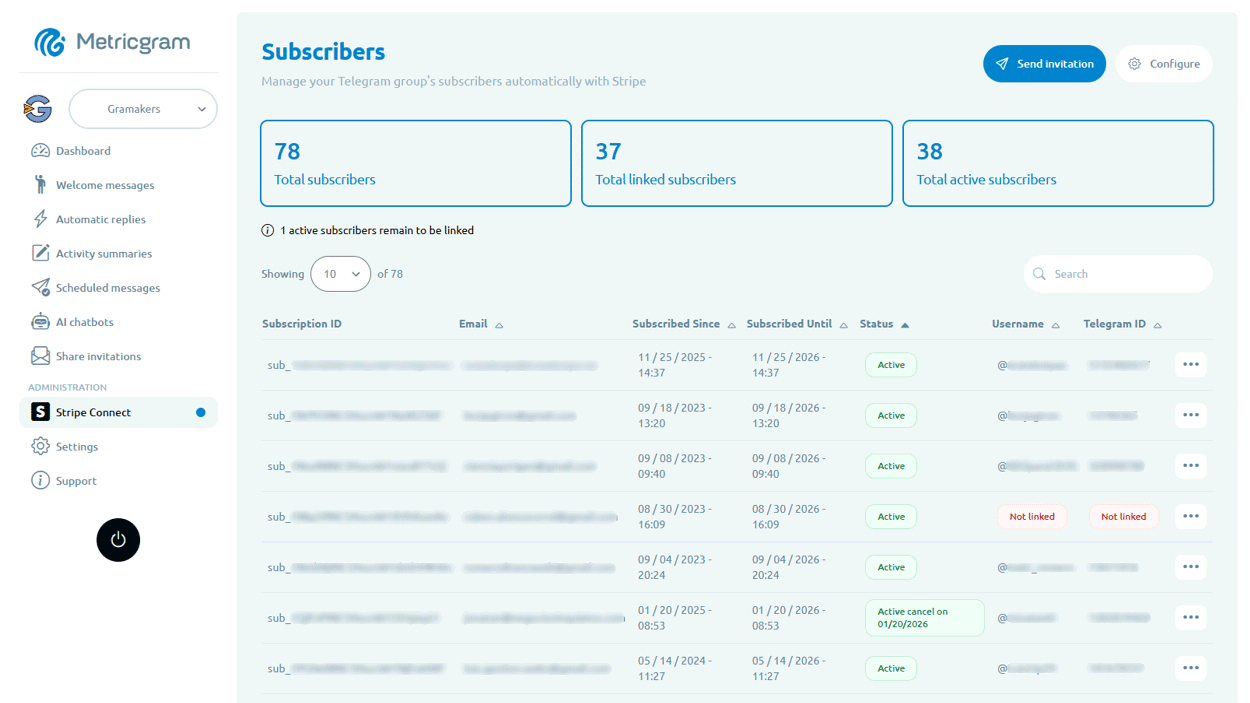
If you want to collect payments for a Telegram group, the cleanest approach is Stripe integration. It handles recurring subscriptions and automatic access management through Stripe. No more chasing monthly payments manually.
Courses and educational products
Once you have an audience that trusts your analysis, selling courses is a natural extension. Record your strategy in a structured format — video modules, PDF workbooks, live workshops. Price it as a one-time purchase ($200-$1,000 depending on depth) and use your group as the distribution channel.
Affiliate partnerships
Brokers, exchanges, and trading platforms pay referral commissions. If you genuinely use and recommend a platform, affiliate income can be significant. Key word: genuinely. Recommending a sketchy offshore broker because they pay higher commissions will cost you credibility that took months to build.
Sponsored analysis
As your group grows, companies in the trading space — data providers, charting platforms, trading journals — may pay for sponsored posts or reviews. Keep these clearly labeled and infrequent. Your members joined for your analysis, not advertisements.
Essential Tools for Trading Group Admins
Running a trading group without the right tools is like trading without charts. You can do it, but why would you?
Analytics and metrics
You cannot improve what you do not measure. Which signals are getting the most engagement? What time do your members open the group? How many active members do you actually have versus lurkers? Data answers these questions. Metricgram gives trading group admins the analytics they need — member activity tracking, engagement metrics, and growth trends — so you can make decisions based on numbers, not feelings.
Payment collection
If you run a paid group, you need automated payment processing. Manual tracking of who paid, who is overdue, and who needs to be removed is a nightmare once you pass 50 subscribers. Stripe Connect integration handles subscriptions, sends reminders, and manages access automatically.
Moderation bots
Anti-spam is non-negotiable. Use bots that automatically filter join requests, detect and remove spam messages, and flag suspicious links. CAS (Combot Anti-Spam) is a good baseline. Layer additional rules on top for your specific needs.
Signal formatting bots
Custom bots can parse your signals into standardized formats, automatically calculate risk-reward ratios, and even post results when take-profit or stop-loss levels are hit. This level of automation makes your group feel professional and saves you hours of manual work.
Content scheduling
Consistency is what separates hobbyist groups from professional ones. Schedule your daily market brief, weekly performance review, and educational content in advance. When members know that market analysis drops every morning at 8 AM, they build a habit of checking your group. You can read more about using scheduling and automation tools in our guide on boosting engagement.
Building Trust and Retention
A trading group lives and dies by trust. Here is how to build it and keep it.
Publish your track record — all of it
Post every trade result, wins and losses. Calculate and share your monthly statistics: total trades, win rate, average R-multiple, maximum drawdown, and net return. Transparency is your strongest marketing tool. When a prospective member sees six months of verified results with honest losing streaks included, that is more convincing than any sales page.
Own your losses publicly
When a signal hits stop loss, do not pretend it did not happen. Post the result, explain what went wrong, and discuss what you would do differently. Members respect honesty far more than a fake perfection narrative. Every experienced trader knows that losses are part of the game.
Engage beyond signals
Reply to questions. Host weekly voice chats for market analysis. Run polls about what members want to learn. The groups with the highest retention are not the ones with the best signals — they are the ones where members feel like they belong to a community. People stay for connection, even when the signals have a rough week.
Create accountability structures
Leaderboards, trading challenges, and shared watchlists turn passive consumers into active participants. When members post their own analysis and get feedback from the community, they become invested in the group's success as well as their own P&L.
For ideas on creating these structures, our deep dive into the best crypto trading Telegram groups breaks down what the top communities are doing differently.
Set expectations early
In your pinned message or welcome sequence, be clear about what the group is and is not. State your trading style, typical risk levels, expected drawdowns, and the fact that trading involves real financial risk. Members who join with realistic expectations stay longer and complain less during losing streaks.
What matters most
Telegram trading groups are not going anywhere. The platform's speed, privacy, and bot ecosystem make it the natural home for trading communities. But the space is messy — full of scams, empty promises, and groups that exist solely to extract money from beginners.
If you are looking for a group to join, take your time. Evaluate the track record, watch the free content, and trust your instincts about the admin's credibility. A good trading group will save you hundreds of hours of research and help you see setups you would have missed.
If you are building a group, invest in transparency, consistency, and community. The signal quality gets you members; the trust and engagement keeps them. And the right tools — analytics, automation, payment processing — turn a side project into a professional operation.
Start with Metricgram to run your trading group with real activity, engagement, and retention data behind your decisions.
Explore More Communities in the Directory
If you want a faster way to compare active Telegram groups by category, language, and positioning, browse the Metricgram directory. It helps you move beyond outdated invite-link lists and quickly shortlist communities that still look active and relevant.
If you run your own group, use the directory as research too: review how other communities describe their niche, frame the value of joining, and present themselves before you publish or promote your own listing.
Ready to manage your Telegram group with Metricgram?
Automate tasks, track analytics, and grow your community with a 14-day free trial. No credit card required.
Start free trialGet weekly Telegram community tips
Join community managers who receive our best tips, guides, and product updates.
You may also like
Telegram For Podcasters: How To Build Listener Community, Paid Access, And Launch Momentum Beyond The RSS Feed
Podcasts are great for trust and habit, but weak for direct listener interaction. This guide explains how podcasters can use Telegram for launch rooms, paid communities, and listener retention without confusing it with podcast hosting.
Telegram For Freelancers: How To Use It For Clients, Leads, And Community Without Creating More Admin Work
Telegram can be useful for freelancers, but only if it has a clear job. This guide explains when to use Telegram for client communication, lead nurturing, paid communities, and peer groups without turning it into operational clutter.