
Telegram + Metricgram vs Skool: which platform should you choose for a paid community?
A practical comparison between Telegram with Metricgram and Skool for paid communities. We look at conversation, courses, payments, onboarding, retention, and operational workload.
Live directory
Browse Metricgram's curated Telegram directory to find active communities by category and language, and see how leading groups position their listings.
Open directoryStart with where the value happens
Skool has become popular with creators, coaches, and education-led communities because it bundles several things in one place: community, courses, calendar, live calls, and payments.
Telegram, on the other hand, was not born as a course platform. It is a messaging and community app. That is exactly why it works so well when the main value is daily conversation, speed, and the feeling of a living group.
This comparison should not be about:
- which one looks more modern
- which one more creators use
- which one has the better landing page
- which one promises more simplicity
The useful question is: What kind of product are you selling, and where does the value really happen for your members?
Quick summary
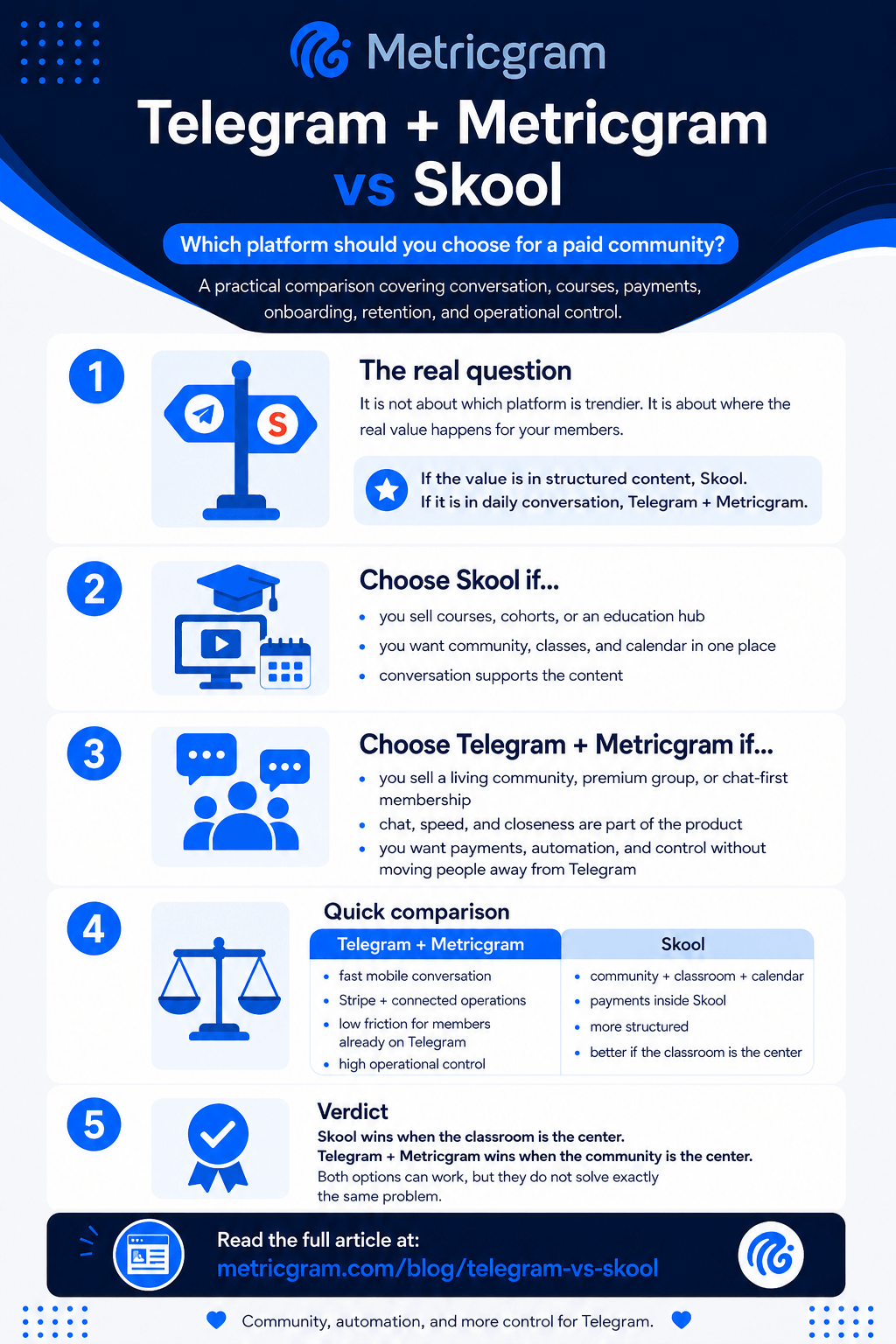
✔️ Choose Skool if your product looks more like a school, cohort, course, or education hub where conversation supports the content.
✔️ Choose Telegram + Metricgram if your product looks like a living community, private group, chat-first membership, premium channel, close support layer, or recurring access where conversation is the product.
Both options can work. They just solve different problems.
Ready to improve your Telegram group? Start your 14-day Metricgram trial.
Start free trialWhat Skool does well
Skool has a clear proposition: put community, courses, calendar, and monetization in one environment.
On its public pricing page, Skool currently shows two main plans:
- Hobby, at $9/month, with unlimited members, courses, videos, and live calls, plus a 10% transaction fee.
- Pro, at $99/month, also with unlimited members, courses, videos, and live calls, plus a 2.9% transaction fee.
Both plans include a custom URL and affiliates.
Skool's big advantage is product simplicity. You do not need to build a stack with several tools. A member enters one place and finds community, classes, and events there.
That reduces decisions.
It also imposes a specific way to operate.
Where Skool can fall short
Skool is a weaker fit when the value is not mainly educational or centered on structured content consumption.
For example:
- groups where daily conversation is the important part
- trading, crypto, business, creator, fan club, or support communities
- memberships where the user wants to open their phone and write quickly
- communities that already live on Telegram
- experiences where access needs to be tightly connected to Stripe, segments, invite sources, or external flows
In those cases, an all-in-one platform can feel heavier than necessary.
The issue is not that Skool is a bad tool. The issue is that it asks you to move the community into a new environment where the experience may not be as direct as opening Telegram and writing.
What Telegram does well
Telegram stands out when the community needs immediacy.
Its strengths for a paid community are:
- familiar mobile app
- fast conversation
- feeling of a living group
- low friction to participate
- private groups and channels
- invite links
- permissions and admins
- strong fit for international communities
- less distance between creator and member
For many businesses, that closeness is worth more than having an integrated classroom.
People do not join a community only to consume modules. They join to ask, answer, see what is happening, share progress, and feel movement.
Telegram is very strong in that layer.
Where Telegram needs Metricgram
Telegram alone does not solve all the operations behind a premium or paid community.
If you charge for access, awkward questions appear sooner or later:
- who has access right now
- what happens when someone cancels
- how a new member gets invited
- how to keep non-paying people out
- how to welcome people without doing it manually
- how to measure activity and retention
- how to automate replies
- how to keep the group clean without watching it all day
That is where Metricgram comes in.
Metricgram does not try to turn Telegram into a course platform. It gives Telegram the operational layer it needs to work as a professional paid community:
- payments and access with Stripe
- subscriber joins and removals
- invitations and access control
- member database
- analytics
- automatic welcomes
- scheduled messages
- automatic replies
- gamification
- AI chatbots
- reports
- management from a web dashboard
- and more
The important difference: you keep the community in Telegram, but you stop managing it like a manual group.
Direct comparison
| Criterion | Telegram + Metricgram | Skool |
|---|---|---|
| Best for | Chat-first communities and premium groups | Courses, cohorts, and education hubs |
| Main experience | Fast mobile conversation | Community + classroom + calendar |
| Onboarding | Telegram with Metricgram automation | Inside Skool |
| Payments | Stripe and group operations connected | Payments inside Skool |
| Courses | Not a course platform | Very strong fit |
| Daily conversation | Very strong | More structured |
| Friction for members already on Telegram | None | Requires moving them to another platform |
| Operational control | High with Metricgram | More closed and packaged |
| Brand ownership | Community lives in Telegram with Metricgram layer | Community lives inside Skool |
| Telegram analytics and automation | Native to Metricgram | Not oriented around Telegram |
When Skool is the better option
Skool is usually better if:
- structured content is the main product
- you want to sell courses inside the same place
- calendar and live calls are central to the experience
- you prefer a closed and simple tool
- the community does not depend on being in Telegram
- your audience accepts registering and returning to the platform to participate
Example: a coach sells an 8-week program with modules, homework, weekly calls, and a community that supports the process. Skool can fit very well there.
When Telegram + Metricgram is the better option
Telegram + Metricgram is usually better if:
- daily conversation is the main value
- you want group video calls
- you already have an audience on Telegram
- you sell access to a private group
- you need to manage joins and cancellations without manual work
- you want Stripe as your payment base
- retention depends on activity, replies, and closeness
- you want automation without moving people away from Telegram
- you need analytics and operations built for groups
Example: a premium or paid community for professionals, founders, traders, creators, fans, educators, or support where the value is daily contact, speed, and access to specific people. Telegram usually feels more natural there.
The all-in-one trap
An all-in-one feels simpler because everything is in the same place.
But real simplicity is not measured by how many tools you use. It is measured by how much friction the member has to participate in the community and how much operational workload the admin carries.
If your audience wants fast chat, moving them into a course hub can complicate something that was simple.
If your product needs a classroom, trying to solve everything with Telegram alone can also fall short.
The right platform is not the one with more features. It is the one that matches your members' real behavior.
The question before choosing
Ask yourself:
If I remove the course part, does the community still have value?
If the answer is no, Skool probably fits better.
If the answer is yes, because the value is in the conversation, access, the group, the answers, and the daily energy, Telegram + Metricgram probably fits better.
Verdict
They are not competing on exactly the same ground.
Skool wins when the classroom is the center.
Telegram + Metricgram wins when the community is the center.
Run a paid Telegram community without manual admin work
Metricgram helps you automate access, payments, welcomes, analytics, and retention so Telegram can work like a serious premium community.
Start free trialGet weekly Telegram community tips
Join community managers who receive our best tips, guides, and product updates.
You may also like
Telegram For Educators: How To Run Cohorts, Student Communities, And Office Hours Without Replacing Your LMS
Telegram is a strong fit for educators when it is used as the live layer around a course or training business. This guide explains how to use it for cohorts, student communities, office hours, and support without turning it into a substitute for your LMS.
Telegram MCP Server: Give AI Agents the Full Telegram Bot API, Safely
What a Telegram MCP server is, why wrapping the Telegram Bot API for AI agents is harder than it looks, and how Metricgram exposes 70+ Bot API methods as secure, group-scoped MCP tools.